To those who think that Osama bin Laden might be alive, two questions:
1. If OBL were alive, wouldn't his #1 priority be to release a new video, showing him holding a newspaper with a current headline (perhaps one announcing his own death), in order to demonstrate that the leaders of the USA are incompetent, or liars not to be trusted, or both, and so rally his followers?
2. Isn't the continuing absence of any such video further evidence that OBL is in fact dead?
I doubt that bin Laden is a fan of western literature, but I am quite sure that, if her were alive, he would love to announce that the reports of his death were an exaggeration.
Monday, May 09, 2011


Wednesday, January 12, 2011
The Rhetoric of Violence
[This is something I wrote in back in August of 2010, but for some reason never published. The recent events in Tucson make me regret not publishing it sooner.]
Republican leaders have gone through the motions of renouncing the threats of violence that have been reported against Democratic leaders during and following the enactment of health care reform, and those Republication leaders seem to consider themselves entirely free of any responsibility for those threats. But those threats are entirely consistent with the rhetoric of the right, including the rhetoric of Republican leaders, and the rhetoric helped to justify violence in the minds of the far right.
Both international law and domestic law recognize times when violence can be justified. The most-well known example in domestic law is the law of self-defense, which allows you to touch, injure, or even kill another person in order to defend yourself against an attack. More broadly, there is a "justification" defense, which allows the use of violence to defend others and not just yourself.
And international law recognizes that a nation may legitimately use force to defend itself against invasions or other foreign threats.
But in each case, the level of violence that can be exerted must be appropriate to the level of violence of the aggressor. You can't respond to verbal threats with physical force, and you can't respond to physical force with deadly violence. In other words, you can't shoot someone who slaps you or shoves you. Similarly, the use of force by nations must be "proportional" to the threat. A country can't bomb a city in response to a border obstruction.
If the health care reform enacted by the Democrats were nothing more than bad policy, bad philosophy, or bad judgment, threats of violence could obviously not be justified, even by the most fervent opponents. But that's not the way the issues were framed by Republicans and conservatives. The health care bill was described as "oppressive" and would deprive Americans of "freedoms." Earlier, there was talk of "death panels." And the procedures used to enact health care reform were attacked as undemocratic and illegitimate. The Republicans described health care reform not merely as bad policy, but as the product of an oppressive, illegitimate government that threatens our life, liberty, and property. They described health care reforms in terms that, if taken literally, would justify armed revolution.
The extremist rhetoric of Republican leaders might not have incited threats of violence by the right, but the rhetoric justified threats of violence. And their defense is that they should not have been taken seriously?
Republican leaders have gone through the motions of renouncing the threats of violence that have been reported against Democratic leaders during and following the enactment of health care reform, and those Republication leaders seem to consider themselves entirely free of any responsibility for those threats. But those threats are entirely consistent with the rhetoric of the right, including the rhetoric of Republican leaders, and the rhetoric helped to justify violence in the minds of the far right.
Both international law and domestic law recognize times when violence can be justified. The most-well known example in domestic law is the law of self-defense, which allows you to touch, injure, or even kill another person in order to defend yourself against an attack. More broadly, there is a "justification" defense, which allows the use of violence to defend others and not just yourself.
And international law recognizes that a nation may legitimately use force to defend itself against invasions or other foreign threats.
But in each case, the level of violence that can be exerted must be appropriate to the level of violence of the aggressor. You can't respond to verbal threats with physical force, and you can't respond to physical force with deadly violence. In other words, you can't shoot someone who slaps you or shoves you. Similarly, the use of force by nations must be "proportional" to the threat. A country can't bomb a city in response to a border obstruction.
If the health care reform enacted by the Democrats were nothing more than bad policy, bad philosophy, or bad judgment, threats of violence could obviously not be justified, even by the most fervent opponents. But that's not the way the issues were framed by Republicans and conservatives. The health care bill was described as "oppressive" and would deprive Americans of "freedoms." Earlier, there was talk of "death panels." And the procedures used to enact health care reform were attacked as undemocratic and illegitimate. The Republicans described health care reform not merely as bad policy, but as the product of an oppressive, illegitimate government that threatens our life, liberty, and property. They described health care reforms in terms that, if taken literally, would justify armed revolution.
The extremist rhetoric of Republican leaders might not have incited threats of violence by the right, but the rhetoric justified threats of violence. And their defense is that they should not have been taken seriously?
Sunday, October 31, 2010
The Pennsylvania Pendulum
A piece of history that's working against Joe Sestak on Tuesday is that, true to the pattern for the past 60 years Pennsylvania will be electing a Republican governor.
For the past 60 years, the voters in Pennsylvania have changed the party in the governor's mansion every eight years, like clockwork. Ed Rendell, a Democrat, has served his eight years, so it's time to elect a Republican governor, and that would be Tom Corbett.
And vote-splitting takes extra effort, so a voter who votes for a Republican governor is more likely to vote for a Republican senator.
Sestak could still be elected to the Senate even if Tom Corbett is elected governor, but it will be a little bit harder, and in a close election that little extra edge could make a difference.
For the past 60 years, the voters in Pennsylvania have changed the party in the governor's mansion every eight years, like clockwork. Ed Rendell, a Democrat, has served his eight years, so it's time to elect a Republican governor, and that would be Tom Corbett.
And vote-splitting takes extra effort, so a voter who votes for a Republican governor is more likely to vote for a Republican senator.
Sestak could still be elected to the Senate even if Tom Corbett is elected governor, but it will be a little bit harder, and in a close election that little extra edge could make a difference.
Sunday, October 17, 2010
Trickle-Up Economics
I suffer from a certain amount of cognitive dissonance every time I hear a conservative politician or pundit talk about the need for tax cuts for the wealthiest 2% of Americans in order to stimulate the economy. What I hear on the news almost every night is that the biggest factor driving the economy is consumer spending, and that they economy is not recovering because consumer spending remains weak.
So, if lack of consumer spending is the problem, the solution should be policies that give consumers more income to spend, right?
No, the mantra from the right is that we need more money in the hands of wealthy individuals and businesses. Of course, the very meaning of "wealthy" is having more income than you need to spend, which means that increasing the disposable income of the wealthy does not increase consumer spending but simply makes the wealthy wealthier. Investments in plants and equipment would also help the economy, but businesses are investing now because the economy is so bad (the kind of self-reinforcing behavior that makes "boom and bust" cycles work), and most investors are not putting their money into new businesses creating new jobs but into government securities, which is why interest rates are so low.
During the Reagan years, the belief that reducing taxes for the rich would stimulate the economy was called "trickle-down economics." But if consumer spending is the issue, then what we really need is trickle-UP economics. We need to adopt policies and programs that put more money into the hands of the lower economic levels where it will translate into consumer spending and economic growth for the entire economy.
The following chart presents empirical evidence of this truth also. This chart was originally published by Slate and it shows the income growth of different income levels during Republican administrations and Democratic administrations based on data compiled by Princeton political science professor Larry M. Bartels.

The chart obviously shows what it was intended to show, which is that the policies of Democratic presidents cause greater economic growth among the lower income levels, while the policies of Republican presidents promote more growth at the higher levels and less growth at the lower levels. But there's another inference which can be derived from the chart, which is that everyone does better when the lowest income levels are rising. For the top 5%, the income growth might be pretty much the same either way, but for everyone else, there is a correlation between income growth at the lowest levels and income growth at all levels.
So it's not necessarily a zero-sum game, and the "class warfare" that conservatives complain about might not be necessary, because policies that benefit the working class are going to benefit the wealthy, but policies that benefit the wealthy don't seem to benefit wage earners.
So, if lack of consumer spending is the problem, the solution should be policies that give consumers more income to spend, right?
No, the mantra from the right is that we need more money in the hands of wealthy individuals and businesses. Of course, the very meaning of "wealthy" is having more income than you need to spend, which means that increasing the disposable income of the wealthy does not increase consumer spending but simply makes the wealthy wealthier. Investments in plants and equipment would also help the economy, but businesses are investing now because the economy is so bad (the kind of self-reinforcing behavior that makes "boom and bust" cycles work), and most investors are not putting their money into new businesses creating new jobs but into government securities, which is why interest rates are so low.
During the Reagan years, the belief that reducing taxes for the rich would stimulate the economy was called "trickle-down economics." But if consumer spending is the issue, then what we really need is trickle-UP economics. We need to adopt policies and programs that put more money into the hands of the lower economic levels where it will translate into consumer spending and economic growth for the entire economy.
The following chart presents empirical evidence of this truth also. This chart was originally published by Slate and it shows the income growth of different income levels during Republican administrations and Democratic administrations based on data compiled by Princeton political science professor Larry M. Bartels.
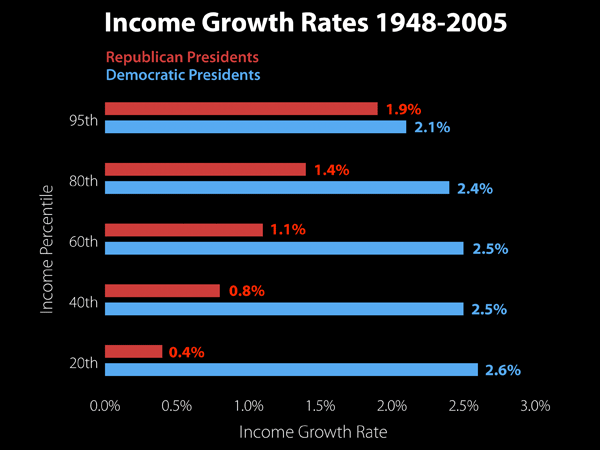
The chart obviously shows what it was intended to show, which is that the policies of Democratic presidents cause greater economic growth among the lower income levels, while the policies of Republican presidents promote more growth at the higher levels and less growth at the lower levels. But there's another inference which can be derived from the chart, which is that everyone does better when the lowest income levels are rising. For the top 5%, the income growth might be pretty much the same either way, but for everyone else, there is a correlation between income growth at the lowest levels and income growth at all levels.
So it's not necessarily a zero-sum game, and the "class warfare" that conservatives complain about might not be necessary, because policies that benefit the working class are going to benefit the wealthy, but policies that benefit the wealthy don't seem to benefit wage earners.
Wednesday, September 29, 2010
Why Health Care Reform Won't Be Repealed
Even if Republicans were to get majorities in both houses of Congress, there really is no likelihood of health care reform being repealed, because repeal won't have full Republican support, despite what Republican may be claiming in their "Pledge to America."
Republicans are claiming to support, and re-enact, all the things that people like. Specifically:
The reason that Republicans won't be able to repeal those parts of the act is that those are the parts of the act that the insurance industry likes. Requiring insurers to provide insurance to sick people without requiring healthy people to buy insurance is a prescription for economic disaster, because there would be nothing to stop healthy people from dropping their coverage until after they get sick. So insurers would have to provide the same (or greater) levels of benefits while the number of insureds shrinks, which would cause premiums to skyrocket.
And Republicans know this, which is why the "Pledge" is so specific about the parts of the act that they would want to keep and so vague about exactly what would be repealed. They know that, if they come right out and say that they are going to repeal the employer and individual mandates, they will be (or at least should be) ridiculed for proposing a completely unworkable system.
So if the Republicans actually try to repeal health care reform with actual legislation, they will be caught between a rock and a hard place. If they repeal the entire health care reform act without providing patient protection they will anger voters, but if they repeal the employer and individual mandates and leave the patient protections in place they will anger (if not bankrupt) some of the biggest contributors.
So it's pretty safe to say that there's going to be lots of rhetoric, but not much actual repeal.
Republicans are claiming to support, and re-enact, all the things that people like. Specifically:
We will make it illegal for an insurance company to deny coverage to someone with prior coverage on the basis of a pre-existing condition, eliminate annual and lifetime spending caps, and prevent insurers from dropping your coverage just because you get sick.Of course, the Patient Protection and Affordable Care Act of 2010 already does all those things, and those are the parts of the act that people like and support. What the Republicans want to get rid of are what are referred to as the "burdensome mandates," such as the requirement that all but the smallest businesses provide health insurance for employees, and the "individual mandate" that requires individuals not covered by employer-provided insurance to get health insurance or pay a special tax.
The reason that Republicans won't be able to repeal those parts of the act is that those are the parts of the act that the insurance industry likes. Requiring insurers to provide insurance to sick people without requiring healthy people to buy insurance is a prescription for economic disaster, because there would be nothing to stop healthy people from dropping their coverage until after they get sick. So insurers would have to provide the same (or greater) levels of benefits while the number of insureds shrinks, which would cause premiums to skyrocket.
And Republicans know this, which is why the "Pledge" is so specific about the parts of the act that they would want to keep and so vague about exactly what would be repealed. They know that, if they come right out and say that they are going to repeal the employer and individual mandates, they will be (or at least should be) ridiculed for proposing a completely unworkable system.
So if the Republicans actually try to repeal health care reform with actual legislation, they will be caught between a rock and a hard place. If they repeal the entire health care reform act without providing patient protection they will anger voters, but if they repeal the employer and individual mandates and leave the patient protections in place they will anger (if not bankrupt) some of the biggest contributors.
So it's pretty safe to say that there's going to be lots of rhetoric, but not much actual repeal.
Tuesday, August 31, 2010
Overreaching by the Pennsylvania AG
The Attorney General of Pennsylvania, Thomas Corbett, is now running for governor, and it will be interesting to see what will happen to Pennsylvania's role in the lawsuit Corbett joined in seeking to have the new health care reform law ("The Patient Protection and Affordable Care Act," H.R. 3590, P.L. 111-148) declared unconstitutional. Corbett was able to join in the lawsuit even though the governor of Pennsylvania, Edward Rendell, is a Democrat who actively supported passage of the health care bill, because the AG of Pennsylvania is an elected office that is largely independent of the governor. So, somewhat ironically, Corbett will be unable to continue to support the lawsuit if he is elected governor, because the next AG will be able to decide whether to proceed.
And Corbett never should have joined in the lawsuit, because it was outside of his powers as AG. If the lawsuit were just challenging the parts of the act that affect state government operations and revenues (mainly the provisions expanding Medicaid, which is a program created by federal law but only partially funded by the federal government), it would have been within his powers to represent the interests of the state, but the lawsuit also challenges the provisions requiring individuals to purchase health insurance (the "individual mandate"), and that is not within the powers of the AG.
The complaint that was filed says that the Attorneys General who are the plaintiffs seek "to protect the individual freedom, public health, and welfare of their citizens and residents" and specifically asks the court to order the federal government not to enforce the act against both the states represented by the AGs and the citizens and residents of those states.
But who gave the Attorney General of Pennsylvania the right to "protect" the individual interests of citizens and the right to represent their individual interests in court? And what if I (or other citizens) don't want the AG representing me in this lawsuit?
There is an allegation in the complaint that the Florida AG has "broad statutory and common law authority to protect the rights of the State of Florida and its people." There is no similar allegation regarding the powers of the Pennsylvania AG, and I don't believe that AG Corbett has the legal power to represent the people of Pennsylvania (i.e., the individual citizens of Pennsylvania separate from the government of Pennsylvania) in this lawsuit.
Section 4.1 of the Pennsylvania Constitution creates the office of Attorney General and declares that the AG " the chief law officer of the Commonwealth and shall exercise such powers and perform such duties as may be imposed by law." The law that seems most relevant is section 204 of the Commonwealth Attorneys Act, Act of October 15, 1980, P.L. 950, 71 P.S. §732-204, which states in subsection (c) that the AG shall represent "the Commonwealth and all Commonwealth agencies" in civil litigation. There is also the power to represent the Commonwealth and its citizens in federal antitrust litigation, but there is no general power to represent the citizens of Pennsylvania in any other kind of civil litigation. (On the inability of the AG to represent private parties, or enter into settlements affecting the rights of private parties, see Commonwealth v. Philip Morris, Inc., 40 Pa.D.& C. 225 (1999).)
It is possible that AG Corbett thinks that the statutory power to "intervene in any other action, including those involving ... the constitutionality of any statute" (71 P.S. §732-204(c)) allows him to join in this lawsuit but, unless the context clearly indicates otherwise, the word "statute" is defined to mean the statutes enacted by the General Assembly of Pennsylvania. 1 Pa.C.S. §1991. (And the context here does not clearly indicate a broader meaning of "statute." Quite the opposite, in fact, because it makes sense to give the AG the duty and power to defend state statutes against challenges to constitutionality, but it makes no sense to give the Pennsylvania AG the general power to challenge the constitutionality of federal statutes.)
The attempt by AG Corbett to challenge the constitutionality of the provisions of federal law which affect individual citizens of Pennsylvania but not the government of Pennsylvania is therefore outside of his power (what lawyers sometimes call "ultra vires") and the courts should deny him any standing to make those challenges.
But that might become moot if the next AG decides to withdraw from the suit.
And Corbett never should have joined in the lawsuit, because it was outside of his powers as AG. If the lawsuit were just challenging the parts of the act that affect state government operations and revenues (mainly the provisions expanding Medicaid, which is a program created by federal law but only partially funded by the federal government), it would have been within his powers to represent the interests of the state, but the lawsuit also challenges the provisions requiring individuals to purchase health insurance (the "individual mandate"), and that is not within the powers of the AG.
The complaint that was filed says that the Attorneys General who are the plaintiffs seek "to protect the individual freedom, public health, and welfare of their citizens and residents" and specifically asks the court to order the federal government not to enforce the act against both the states represented by the AGs and the citizens and residents of those states.
But who gave the Attorney General of Pennsylvania the right to "protect" the individual interests of citizens and the right to represent their individual interests in court? And what if I (or other citizens) don't want the AG representing me in this lawsuit?
There is an allegation in the complaint that the Florida AG has "broad statutory and common law authority to protect the rights of the State of Florida and its people." There is no similar allegation regarding the powers of the Pennsylvania AG, and I don't believe that AG Corbett has the legal power to represent the people of Pennsylvania (i.e., the individual citizens of Pennsylvania separate from the government of Pennsylvania) in this lawsuit.
Section 4.1 of the Pennsylvania Constitution creates the office of Attorney General and declares that the AG " the chief law officer of the Commonwealth and shall exercise such powers and perform such duties as may be imposed by law." The law that seems most relevant is section 204 of the Commonwealth Attorneys Act, Act of October 15, 1980, P.L. 950, 71 P.S. §732-204, which states in subsection (c) that the AG shall represent "the Commonwealth and all Commonwealth agencies" in civil litigation. There is also the power to represent the Commonwealth and its citizens in federal antitrust litigation, but there is no general power to represent the citizens of Pennsylvania in any other kind of civil litigation. (On the inability of the AG to represent private parties, or enter into settlements affecting the rights of private parties, see Commonwealth v. Philip Morris, Inc., 40 Pa.D.& C. 225 (1999).)
It is possible that AG Corbett thinks that the statutory power to "intervene in any other action, including those involving ... the constitutionality of any statute" (71 P.S. §732-204(c)) allows him to join in this lawsuit but, unless the context clearly indicates otherwise, the word "statute" is defined to mean the statutes enacted by the General Assembly of Pennsylvania. 1 Pa.C.S. §1991. (And the context here does not clearly indicate a broader meaning of "statute." Quite the opposite, in fact, because it makes sense to give the AG the duty and power to defend state statutes against challenges to constitutionality, but it makes no sense to give the Pennsylvania AG the general power to challenge the constitutionality of federal statutes.)
The attempt by AG Corbett to challenge the constitutionality of the provisions of federal law which affect individual citizens of Pennsylvania but not the government of Pennsylvania is therefore outside of his power (what lawyers sometimes call "ultra vires") and the courts should deny him any standing to make those challenges.
But that might become moot if the next AG decides to withdraw from the suit.
Thursday, March 25, 2010
Overreaching by the Pennsylvania AG
I was surprised to read that the Attorney General of Pennsylvania, Thomas Corbett, had joined in the lawsuit seeking to have the new health care reform law ("The Patient Protection and Affordable Care Act," H.R. 3590, P.L. 111-148) declared unconstitutional, because the governor of Pennsylvania, Edward Rendell, is a Democrat who actively supported passage of the health care bill. I knew that the AG of Pennsylvania is an elected office, but had forgotten that the current AG is a Republican, not a Democrat. (I live in Pennsylvania and it is a fairly moderate state politically, and tends to alternate regularly between Republican and Democratic administrations.)
If the lawsuit were just challenging the parts of the act that affect state government operations and revenues (mainly the provisions expanding Medicaid, which is a program created by federal law but only partially funded by the federal government), I would be somewhat annoyed, but what really bothers me is that the lawsuit also challenges the provisions requiring individuals to purchase health insurance (the "individual mandate").
The complaint that was filed says that the Attorneys General who are the plaintiffs seek "to protect the individual freedom, public health, and welfare of their citizens and residents" and specifically asks the court to order the federal government not to enforce the act against both the states represented by the AGs and the citizens and residents of those states.
But who gave the Attorney General of Pennsylvania the right to "protect" my individual freedom and the right to represent my individual interests in court? And what if I don't want him representing me in this lawsuit?
There is an allegation in the complaint that the Florida AG has "broad statutory and common law authority to protect the rights of the State of Florida and its people." There is no similar allegation regarding the powers of the Pennsylvania AG, and I don't believe that AG Corbett has the legal power to represent the people of Pennsylvania (i.e., the individual citizens of Pennsylvania separate from the government of Pennsylvania) in this lawsuit.
Section 4.1 of the Pennsylvania Constitution creates the office of Attorney General and declares that the AG " the chief law officer of the Commonwealth and shall exercise such powers and perform such duties as may be imposed by law." The law that seems most relevant is section 204 of the Commonwealth Attorneys Act, Act of October 15, 1980, P.L. 950, 71 P.S. §732-204, which states in subsection (c) that the AG shall represent "the Commonwealth and all Commonwealth agencies" in civil litigation. There is also the power to represent the Commonwealth and its citizens in federal antitrust litigation, but there is no general power to represent the citizens of Pennsylvania in any other kind of civil litigation. (On the inability of the AG to represent private parties, or enter into settlements affecting the rights of private parties, see Commonwealth v. Philip Morris, Inc., 40 Pa.D.& C. 225 (1999).)
It is possible that AG Corbett thinks that the statutory power to "intervene in any other action, including those involving ... the constitutionality of any statute" (71 P.S. §732-204(c)) allows him to join in this lawsuit but, unless unless the context clearly indicates otherwise, the word "statute" is defined to mean the statutes enacted by the General Assembly of Pennsylvania. 1 Pa.C.S. §1991. (And the context here does not clearly indicate a broader meaning of "statute." Quite the opposite, in fact, because it makes sense to give the AG the duty and power to defend state statutes against challenges to constitutionality, but it makes no sense to give the Pennsylvania AG the general power to challenge the constitutionality of federal statutes.)
The attempt by AG Corbett to challenge the constitutionality of the provisions of federal law which affect individual citizens of Pennsylvania but not the government of Pennsylvania is therefore outside of his power (what lawyers sometimes call "ultra vires") and the courts should deny him any standing to make those challenges.
If the lawsuit were just challenging the parts of the act that affect state government operations and revenues (mainly the provisions expanding Medicaid, which is a program created by federal law but only partially funded by the federal government), I would be somewhat annoyed, but what really bothers me is that the lawsuit also challenges the provisions requiring individuals to purchase health insurance (the "individual mandate").
The complaint that was filed says that the Attorneys General who are the plaintiffs seek "to protect the individual freedom, public health, and welfare of their citizens and residents" and specifically asks the court to order the federal government not to enforce the act against both the states represented by the AGs and the citizens and residents of those states.
But who gave the Attorney General of Pennsylvania the right to "protect" my individual freedom and the right to represent my individual interests in court? And what if I don't want him representing me in this lawsuit?
There is an allegation in the complaint that the Florida AG has "broad statutory and common law authority to protect the rights of the State of Florida and its people." There is no similar allegation regarding the powers of the Pennsylvania AG, and I don't believe that AG Corbett has the legal power to represent the people of Pennsylvania (i.e., the individual citizens of Pennsylvania separate from the government of Pennsylvania) in this lawsuit.
Section 4.1 of the Pennsylvania Constitution creates the office of Attorney General and declares that the AG " the chief law officer of the Commonwealth and shall exercise such powers and perform such duties as may be imposed by law." The law that seems most relevant is section 204 of the Commonwealth Attorneys Act, Act of October 15, 1980, P.L. 950, 71 P.S. §732-204, which states in subsection (c) that the AG shall represent "the Commonwealth and all Commonwealth agencies" in civil litigation. There is also the power to represent the Commonwealth and its citizens in federal antitrust litigation, but there is no general power to represent the citizens of Pennsylvania in any other kind of civil litigation. (On the inability of the AG to represent private parties, or enter into settlements affecting the rights of private parties, see Commonwealth v. Philip Morris, Inc., 40 Pa.D.& C. 225 (1999).)
It is possible that AG Corbett thinks that the statutory power to "intervene in any other action, including those involving ... the constitutionality of any statute" (71 P.S. §732-204(c)) allows him to join in this lawsuit but, unless unless the context clearly indicates otherwise, the word "statute" is defined to mean the statutes enacted by the General Assembly of Pennsylvania. 1 Pa.C.S. §1991. (And the context here does not clearly indicate a broader meaning of "statute." Quite the opposite, in fact, because it makes sense to give the AG the duty and power to defend state statutes against challenges to constitutionality, but it makes no sense to give the Pennsylvania AG the general power to challenge the constitutionality of federal statutes.)
The attempt by AG Corbett to challenge the constitutionality of the provisions of federal law which affect individual citizens of Pennsylvania but not the government of Pennsylvania is therefore outside of his power (what lawyers sometimes call "ultra vires") and the courts should deny him any standing to make those challenges.
Wednesday, March 03, 2010
Why Turkeys Run the World
The Senator Bunning/unemployment benefit extension fiasco is another illustration of a fundamental truth that was revealed to me some years ago in a book (more of pamphlet really) titled "Why Turkeys Run the World." The fundamental truth is that real decision-making power does not reside in the people with a goal or a mission or something to accomplish. The real power rests with people without any goal or agenda whatsoever.
Take Senator Bunning (please). The reason he was able to block Senate action was due in large part to the peculiar (to say the least) rules of that body, but the reason he was so successful was that he wasn't actually trying to accomplish anything, or even actually trying to block anything. If he had been trying to accomplish something, then the other Senators could have negotiated with him. But he didn't actually want anything, so there was nothing to offer him. It was his very purposelessness that gave him power.
A similar dynamic was seen in Senator Lieberman's self-indulgent opposition to health care reform. The real problem was not that Lieberman supported health care reform, or that he opposed it, but that he really didn't give a damn one way or another. Not really caring what happened, he had much greater freedom of action, and much greater power, than the Senators who stood for something.
Elections are usually decided by the independents in the middle, not with the stalwarts on either side of the political divide. Similarly, Congressional power resides in the indifferent and the unprincipled, not the dedicated.
Take Senator Bunning (please). The reason he was able to block Senate action was due in large part to the peculiar (to say the least) rules of that body, but the reason he was so successful was that he wasn't actually trying to accomplish anything, or even actually trying to block anything. If he had been trying to accomplish something, then the other Senators could have negotiated with him. But he didn't actually want anything, so there was nothing to offer him. It was his very purposelessness that gave him power.
A similar dynamic was seen in Senator Lieberman's self-indulgent opposition to health care reform. The real problem was not that Lieberman supported health care reform, or that he opposed it, but that he really didn't give a damn one way or another. Not really caring what happened, he had much greater freedom of action, and much greater power, than the Senators who stood for something.
Elections are usually decided by the independents in the middle, not with the stalwarts on either side of the political divide. Similarly, Congressional power resides in the indifferent and the unprincipled, not the dedicated.
Sunday, February 21, 2010
Yoo's Professional Misconduct
Although Associate Deputy Attorney General David Margolis has decided that John Yoo's "poor judgment" did not rise to the level of professional misconduct, the issue is not yet settled, because what is essentially the same issue is being litigated in federal district court, and is now before the 9th Circuit Court of Appeals.
In the recently-released final report of the Office of Professional Responsibility within the U.S. Department of Justice, the OPR concluded that many of the misstatements and omissions in the legal memoranda that John Yoo (then in the Office of Legal Counsel) approved on the use of "enhanced interrogation techniques" were intentional and constituted professional misconduct because he failed to provide legal advice that was thorough, objective, and candid. The OPR concluded that Yoo failed to provide the proper level of legal advice because he "put his desire to accommodate the client" (i.e., the policy makers in the Bush White House) above his professional obligations.
In rejecting the conclusion that the misstatements and omissions constituted professional misconduct, Assoc. Deputy Attorney General Margolis disagreed that Yoo wanted to tell the policy makers within the Bush administration what they wanted to hear, and concluded instead that Yoo was telling the Bush administration what Yoo wanted them to hear. "While I have declined to adopt OPR's findings of misconduct, I fear that John Yoo's loyalty to his own ideology and convictions clouded his view of his obligation to his client and led him to author opinions that reflected his own extreme, albeit sincerely held, views of executive power while speaking for an institutional client."
But is the sincerity of Yoo's ideology a defense to charges of professional misconduct?
That issue may be addressed in a federal district court action brought by Jose Padilla against John Yoo in which Padilla alleges that John Yoo's memos resulted in Padilla's imprisonment (and mistreatment). Padilla v. Yoo, No. 3:08-cv-00035-JSW (U.S.D.C. N.D. Cal.) Yoo moved to dismiss the lawsuit on the grounds that, among other things, he was a federal officer entitled to immunity to suit. In a ruling last June, the court ruled that Yoo was not entitled to immunity because the opinions expressed in Yoo's memos violates "clearly established statutory or constitutional rights of which a reasonable person would have known."
The district court ruling is currently on appeal to the 9th Circuit (No. 09-16478), and one of the issues being argued is whether Padilla's complaint alleges facts that constitute unprofessional conduct by Yoo, and a brief filed by a group of professors of legal ethics say that it does. According to the "amicus" brief filed by "legal ethics scholars" last month, Padilla has alleged that Yoo "stepped beyond his role as a lawyer to participate directly in developing policy in the war on terrorism," and that allegation supports the conclusion that Yoo did not merely give "poor" or "incorrect" legal advice, but gave advice that violated ethical rules.
In other words, Margolis seems to believe that Yoo did not act unethically because he only allowed his own views to interfere with his obligation to give impartial legal advice, while the legal scholars filing the amicus brief with the 9th Circuit believe that Yoo acted unethically because he allowed his own views to interfere with his obligation to give impartial legal advice.
Now, the 9th Circuit is being asked to rule on allegations and not evidence, but the fact that the OPR has already concluded that Yoo's erroneous legal advice was not accidental but intentional suggests that Padilla will be able to prove the same thing. And Padilla may be able to avoid the mistake that the OPR may have made in assuming that Yoo gave bad legal advice to please the White House and failing to consider that Yoo might have given bad legal advice to please himself.
In the recently-released final report of the Office of Professional Responsibility within the U.S. Department of Justice, the OPR concluded that many of the misstatements and omissions in the legal memoranda that John Yoo (then in the Office of Legal Counsel) approved on the use of "enhanced interrogation techniques" were intentional and constituted professional misconduct because he failed to provide legal advice that was thorough, objective, and candid. The OPR concluded that Yoo failed to provide the proper level of legal advice because he "put his desire to accommodate the client" (i.e., the policy makers in the Bush White House) above his professional obligations.
In rejecting the conclusion that the misstatements and omissions constituted professional misconduct, Assoc. Deputy Attorney General Margolis disagreed that Yoo wanted to tell the policy makers within the Bush administration what they wanted to hear, and concluded instead that Yoo was telling the Bush administration what Yoo wanted them to hear. "While I have declined to adopt OPR's findings of misconduct, I fear that John Yoo's loyalty to his own ideology and convictions clouded his view of his obligation to his client and led him to author opinions that reflected his own extreme, albeit sincerely held, views of executive power while speaking for an institutional client."
But is the sincerity of Yoo's ideology a defense to charges of professional misconduct?
That issue may be addressed in a federal district court action brought by Jose Padilla against John Yoo in which Padilla alleges that John Yoo's memos resulted in Padilla's imprisonment (and mistreatment). Padilla v. Yoo, No. 3:08-cv-00035-JSW (U.S.D.C. N.D. Cal.) Yoo moved to dismiss the lawsuit on the grounds that, among other things, he was a federal officer entitled to immunity to suit. In a ruling last June, the court ruled that Yoo was not entitled to immunity because the opinions expressed in Yoo's memos violates "clearly established statutory or constitutional rights of which a reasonable person would have known."
The district court ruling is currently on appeal to the 9th Circuit (No. 09-16478), and one of the issues being argued is whether Padilla's complaint alleges facts that constitute unprofessional conduct by Yoo, and a brief filed by a group of professors of legal ethics say that it does. According to the "amicus" brief filed by "legal ethics scholars" last month, Padilla has alleged that Yoo "stepped beyond his role as a lawyer to participate directly in developing policy in the war on terrorism," and that allegation supports the conclusion that Yoo did not merely give "poor" or "incorrect" legal advice, but gave advice that violated ethical rules.
In other words, Margolis seems to believe that Yoo did not act unethically because he only allowed his own views to interfere with his obligation to give impartial legal advice, while the legal scholars filing the amicus brief with the 9th Circuit believe that Yoo acted unethically because he allowed his own views to interfere with his obligation to give impartial legal advice.
Now, the 9th Circuit is being asked to rule on allegations and not evidence, but the fact that the OPR has already concluded that Yoo's erroneous legal advice was not accidental but intentional suggests that Padilla will be able to prove the same thing. And Padilla may be able to avoid the mistake that the OPR may have made in assuming that Yoo gave bad legal advice to please the White House and failing to consider that Yoo might have given bad legal advice to please himself.
Friday, February 05, 2010
The Upcoming Tax Brawl
There's been some media attention to the strange one-year repeal of the federal estate tax, and a few comments on the failure of Congress to pass an "extenders" bill to prevent a number of tax provisions from expiring at the end of 2009, but I have yet to see any public comment on what will be THE political story of 2010, which is that all of the Bush tax cuts will be expiring at the end of the year and, unless Congress acts, almost every tax-paying American will be paying more in federal income tax next year.
For the wealthiest Americans, allowing the Bush tax cuts to "sunset" will be quite a shock. A family of four with $500,000 of income filing a joint return with no itemized deductions would pay $136,208 in federal income tax in 2010, but will have to pay $158,801 in 2011, a $22,607 increase, unless Congress acts. If that $500,000 of income includes qualified dividend income, which is taxed at the capital gain rate of 15% instead of the maximum rate of 35% on ordinary income, the results are even more dramatic. In 2010, $500,000 of income with $250,000 of qualified dividends would result in $89,201 of federal tax, but in 2011 the tax jumps up to $158,801, an increase of $69,600, or almost 80%, in only one year.
Barack Obama campaigned on the pledge (which he has repeated several times since being elected), that he will not raise taxes for those earning less than $250,000. For a family of four with $250,000 of income, their tax bill is $51,701 under current law, but goes to $59,341 in 2011, a $7,640 increase.
Reducing the family's income reduces the impact, but the impact is still there. For a family earning $50,000, the tax bill would be $2,763 under current law, but jumps to $3,878, more than $1,000 more, in 2010.
Even a family earning as little as $30,000 would be affected. That family would owe $400 in federal income tax in 2010, but if the 10% tax bracket and marriage penalty relief both expire, that family's tax bill more than doubles, going from $400 to $878.
And here is where the Senate will jump into inaction. As we have seen very clearly in the attempt at health care reform, it takes only 41 Republican votes in the Senate (which the Republicans now have with newly-elected Scott Brown seated) to block any attempt to raise income tax rates for the wealthy. But these tax increases are already enacted and will happen if Congress does nothing, and it also takes only 41 Democratic votes in the Senate (or the Democratic majority in the more progressive House) to block any extension of the tax cuts for the wealthy.
So it's going to be like health care, only worse. At least with health care, Republicans paid lip service to the idea of reform and compromise, but when it comes to taxes Republicans are going to even pretend to be interested in negotiating with Democrats. With increasing pressure from "tea partiers" and the extreme right, and facing election battles at the end of 2010, Republicans have no reason to do anything but draw a hard line and insist on making the Bush tax cuts permanent.
And Republicans also have every reason to block anything the Democrats try to enact, because they would really like to go into the 2010 election being able to point to enormous tax increases on working Americans in 2011 and blaming it on the Democrats who control Congress.
So it's going to be bloody. It's going to be a bare-knuckled street brawl with knives and chains, and if the Democrats don't get their act together and enact real tax reform before November, they're going to find themselves down on the ground, bloody, and being kicked in the face.
For the wealthiest Americans, allowing the Bush tax cuts to "sunset" will be quite a shock. A family of four with $500,000 of income filing a joint return with no itemized deductions would pay $136,208 in federal income tax in 2010, but will have to pay $158,801 in 2011, a $22,607 increase, unless Congress acts. If that $500,000 of income includes qualified dividend income, which is taxed at the capital gain rate of 15% instead of the maximum rate of 35% on ordinary income, the results are even more dramatic. In 2010, $500,000 of income with $250,000 of qualified dividends would result in $89,201 of federal tax, but in 2011 the tax jumps up to $158,801, an increase of $69,600, or almost 80%, in only one year.
Barack Obama campaigned on the pledge (which he has repeated several times since being elected), that he will not raise taxes for those earning less than $250,000. For a family of four with $250,000 of income, their tax bill is $51,701 under current law, but goes to $59,341 in 2011, a $7,640 increase.
Reducing the family's income reduces the impact, but the impact is still there. For a family earning $50,000, the tax bill would be $2,763 under current law, but jumps to $3,878, more than $1,000 more, in 2010.
Even a family earning as little as $30,000 would be affected. That family would owe $400 in federal income tax in 2010, but if the 10% tax bracket and marriage penalty relief both expire, that family's tax bill more than doubles, going from $400 to $878.
And here is where the Senate will jump into inaction. As we have seen very clearly in the attempt at health care reform, it takes only 41 Republican votes in the Senate (which the Republicans now have with newly-elected Scott Brown seated) to block any attempt to raise income tax rates for the wealthy. But these tax increases are already enacted and will happen if Congress does nothing, and it also takes only 41 Democratic votes in the Senate (or the Democratic majority in the more progressive House) to block any extension of the tax cuts for the wealthy.
So it's going to be like health care, only worse. At least with health care, Republicans paid lip service to the idea of reform and compromise, but when it comes to taxes Republicans are going to even pretend to be interested in negotiating with Democrats. With increasing pressure from "tea partiers" and the extreme right, and facing election battles at the end of 2010, Republicans have no reason to do anything but draw a hard line and insist on making the Bush tax cuts permanent.
And Republicans also have every reason to block anything the Democrats try to enact, because they would really like to go into the 2010 election being able to point to enormous tax increases on working Americans in 2011 and blaming it on the Democrats who control Congress.
So it's going to be bloody. It's going to be a bare-knuckled street brawl with knives and chains, and if the Democrats don't get their act together and enact real tax reform before November, they're going to find themselves down on the ground, bloody, and being kicked in the face.
Sunday, January 24, 2010
Dred Scott v. Citizens United
In Dred Scott v. Sandford, 60 U.S. 393 (1857), the Supreme Court declared that, whether of not someone was a "person" within the meaning of the Constitution was to be determined solely by reference to the Constitution, and Congress and the States had no say in the matter. Specifically, a person descended from a person imported as a slave could never be a "citizen" or a "person" within the meaning of the Constitution.
The decision is widely regarded as one of the worst in the history of the United States. It perpetuated slavery, it lead to the Civil War, and it was directly refuted by the 14th Amendment, one of only four (at most) Supreme Court opinions to have been reversed by constitutional amendments.
The recent Supreme Court decision in Citizens United v. Federal Election Commission, 558 U.S. ___, No. 08-205 (1/21/2010), goes to the opposite extreme, because it holds that anything that a state declares to be a "person" is a "person" for all purposes of the Constitution, and Congress has no say in the matter.
The Dred Scott decision eviscerated the federal government by declaring that whether a slave was a "person" was determined solely by constitutional law and Congress was powerless.
The Citizens United decision eviscerates the federal government by declaring that whether a corporate is a "person" is determined solely by state law and Congress is powerless.
Let's hope that fewer Americans die this time.
The decision is widely regarded as one of the worst in the history of the United States. It perpetuated slavery, it lead to the Civil War, and it was directly refuted by the 14th Amendment, one of only four (at most) Supreme Court opinions to have been reversed by constitutional amendments.
The recent Supreme Court decision in Citizens United v. Federal Election Commission, 558 U.S. ___, No. 08-205 (1/21/2010), goes to the opposite extreme, because it holds that anything that a state declares to be a "person" is a "person" for all purposes of the Constitution, and Congress has no say in the matter.
The Dred Scott decision eviscerated the federal government by declaring that whether a slave was a "person" was determined solely by constitutional law and Congress was powerless.
The Citizens United decision eviscerates the federal government by declaring that whether a corporate is a "person" is determined solely by state law and Congress is powerless.
Let's hope that fewer Americans die this time.
Taxing Political Expenditures
The Supreme Court's recent decision in Citizens United v. Federal Election Commission severely restricts the ability of Congress to regulate, much less prohibit, the use of corporate money to influence elections, but what about Congress's power to tax that money?
As it is now, corporations cannot claim expenses of attempting to influence elections or legislation as business expense (see Internal Revenue Code section 162(e)). So corporate profits that are spent on electioneering are effectively subject to income tax at the corporate level. The shareholders bear the burden of the tax, but very indirectly.
But what if the expenses of electioneering were considered a form of a dividend?
This is not unprecedented, because there are lots of places in the Internal Revenue Code in which something that looks like one thing is recharacterized as something else. To take just one example, IRC section 7872 says that if a corporation makes an interest-free loan to a shareholder, the loan is recharacterized as an interest-bearing loan at a market rate of interest, with imputed interest payments by the shareholder to the corporation and imputed dividend payments in the same amounts by the corporation to the shareholder. There are also many rulings and court decisions in which officers or shareholders who have used corporate money to pay personal expenses are held to have received either compensation or dividends from the corporation.
So it would not be unreasonable for Congress to say that, if a corporation uses its money to advance the personal political beliefs of the officers or shareholders, that money should be considered to be payments to those officers or shareholders. For most publicly-traded corporations, dividends are not tax-deductible by the corporation, so income paid out as dividends is taxed twice, once at the corporate level and again at the shareholder level.
But the really nasty part is that Congress could offer corporations a choice: If the political expenses are approved by the shareholders, then the expenses could be considered a dividend to those shareholders, but if the political expenses are approved only by the board of directors, then the income falls on the directors alone.
Neither alternative is going to be very appealing to corporations. Getting shareholder approval for political spending could turn shareholder meetings into political battles, and stock prices could suffer if investors decide that they don't want to own a stock that pays a dividend of $10 while the investor has $12 of taxable income. But directors are certainly not going to want to pay personal income tax on what might be millions of dollars of income they never actually received.
Taxing directors or shareholders on the money spent on corporate electioneering might not solve the problem of corporate influence, but it might make it more difficult and more painful.
As it is now, corporations cannot claim expenses of attempting to influence elections or legislation as business expense (see Internal Revenue Code section 162(e)). So corporate profits that are spent on electioneering are effectively subject to income tax at the corporate level. The shareholders bear the burden of the tax, but very indirectly.
But what if the expenses of electioneering were considered a form of a dividend?
This is not unprecedented, because there are lots of places in the Internal Revenue Code in which something that looks like one thing is recharacterized as something else. To take just one example, IRC section 7872 says that if a corporation makes an interest-free loan to a shareholder, the loan is recharacterized as an interest-bearing loan at a market rate of interest, with imputed interest payments by the shareholder to the corporation and imputed dividend payments in the same amounts by the corporation to the shareholder. There are also many rulings and court decisions in which officers or shareholders who have used corporate money to pay personal expenses are held to have received either compensation or dividends from the corporation.
So it would not be unreasonable for Congress to say that, if a corporation uses its money to advance the personal political beliefs of the officers or shareholders, that money should be considered to be payments to those officers or shareholders. For most publicly-traded corporations, dividends are not tax-deductible by the corporation, so income paid out as dividends is taxed twice, once at the corporate level and again at the shareholder level.
But the really nasty part is that Congress could offer corporations a choice: If the political expenses are approved by the shareholders, then the expenses could be considered a dividend to those shareholders, but if the political expenses are approved only by the board of directors, then the income falls on the directors alone.
Neither alternative is going to be very appealing to corporations. Getting shareholder approval for political spending could turn shareholder meetings into political battles, and stock prices could suffer if investors decide that they don't want to own a stock that pays a dividend of $10 while the investor has $12 of taxable income. But directors are certainly not going to want to pay personal income tax on what might be millions of dollars of income they never actually received.
Taxing directors or shareholders on the money spent on corporate electioneering might not solve the problem of corporate influence, but it might make it more difficult and more painful.
Friday, October 23, 2009
How Do Hate Crimes Affect Interstate Commerce?
And is there anything left that does not affect interstate commerce?
The question arises because the U.S. Constitution did not give Congress the power to legislate generally, over any subject, but only over the subjects listed in the Constitution, one of which is the regulation of interstate commerce.
And so, in S. 909, the "Matthew Shepard and and James Byrd Jr. Hate Crimes Prevention Act," which yesterday became part of the 2010 defense appropriate act (S. 1390), Congress dutifully found that violence motivated by bias "affects interstate commerce."
Really?
When the Constitution was first proposed and then ratified in the late 1700s, interstate commerce was relatively limited. Most food was grown within a few miles of where it was eaten, and most goods were manufactured locally, and by hand. The industrial revolution was just beginning, and the only means of transporting goods long distances was by horse-drawn wagon or by sea.
As our economy has grown larger and more complicated, the importance of interstate commerce has also grown. Today, it's difficult to find anything in any store that was not either grown or manufactured in a different state or includes materials from a different state. And as interstate commerce grew, the power of Congress grew, so that Congress began regulating not just railroads and the interstate movement of goods, but also agriculture, manufacturing, working conditions, and product safety.
When it involves interstate commerce, Congress can legislate against discrimination and bias. The Civil Rights Act of 1965, which made it illegal for hotels, restaurants, and other public accommodations to discriminate based on race was based on the power of Congress to regulate interstate commerce, because there is no power in Congress to legislate against discrimination generally. (The 14th Amendment prohibits states from denying equal protection and does not prohibit private discrimination.) Later legislation has prohibited discrimination in housing and employment, and has extended to not just racial discrimination but also discrimination based on gender, ethnicity, religion, and disabilities.
I agree with all of this. We have a national economy, and we should have national laws regulating that economy. But do two homophobes beating up a gay man outside of a bar really affect the national economy?
According to Congress, it does. Section 2 of S. 909 states (in part) that violence motivated by bias:
The statute itself limits the crimes relating to gender, religious, gender identity, and other biases to those occurring "during the course of, or as the result of, the travel of the defendant or the victim--(I) across a State line or national border; or (II) using a channel, facility, or instrumentality of interstate or foreign commerce," those committed using a "channel, facility, or instrumentality of interstate or foreign commerce" or using a "firearm, dangerous weapon, explosive or incendiary device, or other weapon that has traveled in interstate or foreign commerce," and those that "interferes with commercial or other economic activity in which the victim is engaged at the time of the conduct" or "otherwise affects interstate or foreign commerce."
It's difficult to imagine any crime of violence, anywhere, that wouldn't fall under one of those categories. For example, it's pretty safe to say that guns, knives, and even baseball bats are manufactured and sold in interstate commerce, so any crime, committed with any gun, knife, or baseball bat that ever crossed any state line, can now be a federal crime.
And my hypothetical about two homophobes beating up a gay man outside of a bar is a crime falling within the new statute if the fight arose after the victim bought a beer in the bar (which is interstate commerce) or caused the victim to miss a day of work (which affects interstate commerce).
United States v. Lopez, 514 U.S. 549 (1995), is often cited as limiting Congressional power, because in that case the Supreme Court ruled unconstitutional a law that made it a crime to carry a gun within a "school zone," rejecting arguments raised by the government that violence near schools will affect interstate commerce. However, the statute in question did not include any specific requirement that the crime be found to be "in interstate commerce" or "affect interstate commerce," and there were no findings by Congress about how the presence of guns near schools would affect interstate commerce, so the decision could be distinguished from S. 909 and it is not clear how the Supreme Court will react to "findings" and statutory "limits" like those found in S. 909.
One would think that there is a limit to congressional power, and that Congress cannot extend its power merely because the crime is carried out using some weapon that once crossed a state line, or because of some relatively minor and unintended economic consequence of the crime. But maybe not.
The question arises because the U.S. Constitution did not give Congress the power to legislate generally, over any subject, but only over the subjects listed in the Constitution, one of which is the regulation of interstate commerce.
And so, in S. 909, the "Matthew Shepard and and James Byrd Jr. Hate Crimes Prevention Act," which yesterday became part of the 2010 defense appropriate act (S. 1390), Congress dutifully found that violence motivated by bias "affects interstate commerce."
Really?
When the Constitution was first proposed and then ratified in the late 1700s, interstate commerce was relatively limited. Most food was grown within a few miles of where it was eaten, and most goods were manufactured locally, and by hand. The industrial revolution was just beginning, and the only means of transporting goods long distances was by horse-drawn wagon or by sea.
As our economy has grown larger and more complicated, the importance of interstate commerce has also grown. Today, it's difficult to find anything in any store that was not either grown or manufactured in a different state or includes materials from a different state. And as interstate commerce grew, the power of Congress grew, so that Congress began regulating not just railroads and the interstate movement of goods, but also agriculture, manufacturing, working conditions, and product safety.
When it involves interstate commerce, Congress can legislate against discrimination and bias. The Civil Rights Act of 1965, which made it illegal for hotels, restaurants, and other public accommodations to discriminate based on race was based on the power of Congress to regulate interstate commerce, because there is no power in Congress to legislate against discrimination generally. (The 14th Amendment prohibits states from denying equal protection and does not prohibit private discrimination.) Later legislation has prohibited discrimination in housing and employment, and has extended to not just racial discrimination but also discrimination based on gender, ethnicity, religion, and disabilities.
I agree with all of this. We have a national economy, and we should have national laws regulating that economy. But do two homophobes beating up a gay man outside of a bar really affect the national economy?
According to Congress, it does. Section 2 of S. 909 states (in part) that violence motivated by bias:
substantially affects interstate commerce in many ways, including the following:
(A) The movement of members of targeted groups is impeded, and members of such groups are forced to move across State lines to escape the incidence or risk of such violence.
(B) Members of targeted groups are prevented from purchasing goods and services, obtaining or sustaining employment, or participating in other commercial activity.
(C) Perpetrators cross State lines to commit such violence.
(D) Channels, facilities, and instrumentalities of interstate commerce are used to facilitate the commission of such violence.
(E) Such violence is committed using articles that have traveled in interstate commerce.
The statute itself limits the crimes relating to gender, religious, gender identity, and other biases to those occurring "during the course of, or as the result of, the travel of the defendant or the victim--(I) across a State line or national border; or (II) using a channel, facility, or instrumentality of interstate or foreign commerce," those committed using a "channel, facility, or instrumentality of interstate or foreign commerce" or using a "firearm, dangerous weapon, explosive or incendiary device, or other weapon that has traveled in interstate or foreign commerce," and those that "interferes with commercial or other economic activity in which the victim is engaged at the time of the conduct" or "otherwise affects interstate or foreign commerce."
It's difficult to imagine any crime of violence, anywhere, that wouldn't fall under one of those categories. For example, it's pretty safe to say that guns, knives, and even baseball bats are manufactured and sold in interstate commerce, so any crime, committed with any gun, knife, or baseball bat that ever crossed any state line, can now be a federal crime.
And my hypothetical about two homophobes beating up a gay man outside of a bar is a crime falling within the new statute if the fight arose after the victim bought a beer in the bar (which is interstate commerce) or caused the victim to miss a day of work (which affects interstate commerce).
United States v. Lopez, 514 U.S. 549 (1995), is often cited as limiting Congressional power, because in that case the Supreme Court ruled unconstitutional a law that made it a crime to carry a gun within a "school zone," rejecting arguments raised by the government that violence near schools will affect interstate commerce. However, the statute in question did not include any specific requirement that the crime be found to be "in interstate commerce" or "affect interstate commerce," and there were no findings by Congress about how the presence of guns near schools would affect interstate commerce, so the decision could be distinguished from S. 909 and it is not clear how the Supreme Court will react to "findings" and statutory "limits" like those found in S. 909.
One would think that there is a limit to congressional power, and that Congress cannot extend its power merely because the crime is carried out using some weapon that once crossed a state line, or because of some relatively minor and unintended economic consequence of the crime. But maybe not.
Friday, August 14, 2009
Health Care Dichotomy
Conservatives seem to be expressing two fears about health care reform:
1. The government will intrude into the patient-doctor relationship, interfering with things like end-of-life decisions.
2. The government will NOT intrude into the patient-doctor relationship, allowing things like legal abortions.
The first fear is especially peculiar, because it was conservatives who wanted the federal government to intrude into the end-of-life decisions of the Schiavo family.
The lesson I draw from this is that conservatives don't want the government intruding into your decisions as long as you make the decisions that conservatives approve of. If you make any other decision, well then the government will have to step in.
In which case, it's your own fault for not being more moral and sensible.
1. The government will intrude into the patient-doctor relationship, interfering with things like end-of-life decisions.
2. The government will NOT intrude into the patient-doctor relationship, allowing things like legal abortions.
The first fear is especially peculiar, because it was conservatives who wanted the federal government to intrude into the end-of-life decisions of the Schiavo family.
The lesson I draw from this is that conservatives don't want the government intruding into your decisions as long as you make the decisions that conservatives approve of. If you make any other decision, well then the government will have to step in.
In which case, it's your own fault for not being more moral and sensible.
Monday, July 27, 2009
Palin the Usurper
While watching a Sarah Palin retrospective tonight, following her resignation as governor of Alaska, a question occurred to me:
Was the election of Barack Obama, a former president of Harvard Law Review and Senator from Illinois, as the first African-American President of the United States, almost upstaged/eclipsed (or was it upstaged/eclipsed?) by a former beauty pagent contestant who was an unsuccessful candidate for Vice-President of the United States?
On "This Week with George Stephanapolous" on 7/26, conservative commentator George Will complained about the continuing over-exposure given to the pronouncements of Barack Obama on every subject. But hasn't Obama at least been elected to a national office? How do we explain the continuing attention given to the utterances of Sarah Palin?
Was the election of Barack Obama, a former president of Harvard Law Review and Senator from Illinois, as the first African-American President of the United States, almost upstaged/eclipsed (or was it upstaged/eclipsed?) by a former beauty pagent contestant who was an unsuccessful candidate for Vice-President of the United States?
On "This Week with George Stephanapolous" on 7/26, conservative commentator George Will complained about the continuing over-exposure given to the pronouncements of Barack Obama on every subject. But hasn't Obama at least been elected to a national office? How do we explain the continuing attention given to the utterances of Sarah Palin?
Tuesday, June 16, 2009
Yoo, Torture Memos, and "Reasonable Officials"
On June 12, a federal judge has issued a stinging rebuke to John Yoo for the opinions he wrote for the Bush administration supporting indefinite detentions and "harsh interrogations." The judge ruled that Yoo's opinions were not merely wrong, but were unreasonably wrong when applied to an American citizen classified as an "enemy combatant."
This should be the first of many judicial opinions that forcefully and unequivocably reject the reasoning of Yoo's "torture memos."
The ruling was in a civil action filed by Jose Padilla against John Yoo in which Padilla has claimed that Yoo's legal opinions, written by Yoo while he was serving in the Department of Justice, caused Padilla to be deprived of civil rights. The complaint alleges unconstitutional detention without due process of law and mental and physical abuse. In rejecting Yoo's claim of immunity from personal liability for acts he performed while an official of the federal government, the judge held that Yoo's legal opinions were unreasonably wrong because Padilla's constitutional rights were "clearly established."
Some background: Jose Padilla is a citizen of the United States who was arrested at Chicago's O'Hare airport, initially charged with conspiracy to construct a "dirty" (i.e., radioactive) bomb, but then turned over to the military who held him in near-solitary confinement for almost four years before he was finally returned to the civilian courts where he pled guilty to crimes less serious than the ones he was initially charged with. (He could not have been convicted of the crimes for which he was originally charged because the original charges were dismissed "with prejudice" when the Bush administration insisted he be surrendered to military custody, and so the dismissal barred any future prosecution for the same crimes due to the constitutional prohibition of double jeopardy for the same offense.)
John Yoo was an official of the White House, and then the Office of Legal Counsel in the Department of Justice, and his legal opinions formed the basis for the Bush adminstrations claims of the powers of the President to order detentions and "harsh interrogations" notwithstanding constitutional guarantees of due process and statutory prohibitions against torture.
In 2008, and after his conviction, Padilla and his mother filed suit against Yoo, claiming that as a result of Yoo's legal opinions Padilla had been detained without charge and without access to legal counsel and had been subjected to severe and prolonged isolation, sleep deprivation, extreme temperatures, painful stress positions, threats of death, and other forms of physical and mental abuse. Padilla and his mother asked for a judgment that those conditions were unlawful and unconstitional, for $1 (one dollar) in damages, and for other relief. Padilla v. Yoo, No. 3:08-cv-00035-JSW (U.S.D.C. N.D. Cal. 1/4/2008).
After some procedural sparring, Yoo moved to dismiss the complaint for failure to state a proper cause of action. In deciding this motion, the court did not decide whether what Padilla claimed was true, but merely whether Padilla could win the lawsuit against Yoo if it turned out that everything that Padilla had alleged was actually true. In deciding this motion, the court addressed two major issues:
1. Whether there is a cause of action and legal remedy in court for these kinds of allegations; and, if there is a cause of action
2. Whether the action is foreclosed by the usual immunity of government officials from any personal financial liability for their actions performed in the course of their duties.
On the first issue, the court ruled that the decision of the Supreme Court in Bivens v. Six Unknown Named Agents, 403 U.S. 388 (1971), which held that a lawsuit could exist for violations of the constitution, required the court to find a civil remedy for Padilla even though neither the Constitution nor any federal statute expressly stated that Padilla could sue Yoo. (This is an issue that will almost certainly be contested on appeal.)
On the second and at present more interesting issue, the court pointed out that the immunity of government officials for personal liability is a "qualified" immunity, which means that the official is immune unless their conduct violates "any clearly established statutory or constitutional rights of which a resonable person would have known." The court then stated that, in determining whether a government official should be held personally liable for questioned conduct, the issue was "whether, under that clearly established law, a reasonable official could have believed that the conduct was lawful." Applying that standard to the allegations made by Padilla against Yoo, the court then reached the following conclusions:
1. Yoo could be held responsible for deprivations of constitutional rights consistent with his legal opinions because "government lawyers are responsible for the foreseeable consequences of their conduct" and Padilla alleged circumstances that made his mistreatment reasonably foreseeable by Yoo.
2. Padilla sufficiently alleged that his constitutional rights were violated by denial of access to courts in violation of the 5th Amendment and cruel and unusual treatments that would be violations of the 8th Amendment.
3. Padilla's constitutional rights were "clearly established." In reaching this conclusion, the court rejected Yoo's arguments that the presidential designation of Padilla as an "enemy combatant" created any uncertainty about Padilla's constitutional rights.
The necessary, if not explicit, implication of the court's holdings is that Yoo's legal conclusions were not just wrong, but were not the conclusions of a "reasonable" federal officer. Padilla v. Yoo, No. 3:08-cv-00035-JSW (U.S.D.C. N.D. Cal. 6/12/2009).
Still to come is the report of the Department of Justice's Office of Legal Counsel on whether the opinions of John Yoo and Jay Bybee departed from professional standards to such an extent that they should be disciplined for failing to adhere to the rules of professional conduct.
This should be the first of many judicial opinions that forcefully and unequivocably reject the reasoning of Yoo's "torture memos."
The ruling was in a civil action filed by Jose Padilla against John Yoo in which Padilla has claimed that Yoo's legal opinions, written by Yoo while he was serving in the Department of Justice, caused Padilla to be deprived of civil rights. The complaint alleges unconstitutional detention without due process of law and mental and physical abuse. In rejecting Yoo's claim of immunity from personal liability for acts he performed while an official of the federal government, the judge held that Yoo's legal opinions were unreasonably wrong because Padilla's constitutional rights were "clearly established."
Some background: Jose Padilla is a citizen of the United States who was arrested at Chicago's O'Hare airport, initially charged with conspiracy to construct a "dirty" (i.e., radioactive) bomb, but then turned over to the military who held him in near-solitary confinement for almost four years before he was finally returned to the civilian courts where he pled guilty to crimes less serious than the ones he was initially charged with. (He could not have been convicted of the crimes for which he was originally charged because the original charges were dismissed "with prejudice" when the Bush administration insisted he be surrendered to military custody, and so the dismissal barred any future prosecution for the same crimes due to the constitutional prohibition of double jeopardy for the same offense.)
John Yoo was an official of the White House, and then the Office of Legal Counsel in the Department of Justice, and his legal opinions formed the basis for the Bush adminstrations claims of the powers of the President to order detentions and "harsh interrogations" notwithstanding constitutional guarantees of due process and statutory prohibitions against torture.
In 2008, and after his conviction, Padilla and his mother filed suit against Yoo, claiming that as a result of Yoo's legal opinions Padilla had been detained without charge and without access to legal counsel and had been subjected to severe and prolonged isolation, sleep deprivation, extreme temperatures, painful stress positions, threats of death, and other forms of physical and mental abuse. Padilla and his mother asked for a judgment that those conditions were unlawful and unconstitional, for $1 (one dollar) in damages, and for other relief. Padilla v. Yoo, No. 3:08-cv-00035-JSW (U.S.D.C. N.D. Cal. 1/4/2008).
After some procedural sparring, Yoo moved to dismiss the complaint for failure to state a proper cause of action. In deciding this motion, the court did not decide whether what Padilla claimed was true, but merely whether Padilla could win the lawsuit against Yoo if it turned out that everything that Padilla had alleged was actually true. In deciding this motion, the court addressed two major issues:
1. Whether there is a cause of action and legal remedy in court for these kinds of allegations; and, if there is a cause of action
2. Whether the action is foreclosed by the usual immunity of government officials from any personal financial liability for their actions performed in the course of their duties.
On the first issue, the court ruled that the decision of the Supreme Court in Bivens v. Six Unknown Named Agents, 403 U.S. 388 (1971), which held that a lawsuit could exist for violations of the constitution, required the court to find a civil remedy for Padilla even though neither the Constitution nor any federal statute expressly stated that Padilla could sue Yoo. (This is an issue that will almost certainly be contested on appeal.)
On the second and at present more interesting issue, the court pointed out that the immunity of government officials for personal liability is a "qualified" immunity, which means that the official is immune unless their conduct violates "any clearly established statutory or constitutional rights of which a resonable person would have known." The court then stated that, in determining whether a government official should be held personally liable for questioned conduct, the issue was "whether, under that clearly established law, a reasonable official could have believed that the conduct was lawful." Applying that standard to the allegations made by Padilla against Yoo, the court then reached the following conclusions:
1. Yoo could be held responsible for deprivations of constitutional rights consistent with his legal opinions because "government lawyers are responsible for the foreseeable consequences of their conduct" and Padilla alleged circumstances that made his mistreatment reasonably foreseeable by Yoo.
2. Padilla sufficiently alleged that his constitutional rights were violated by denial of access to courts in violation of the 5th Amendment and cruel and unusual treatments that would be violations of the 8th Amendment.
3. Padilla's constitutional rights were "clearly established." In reaching this conclusion, the court rejected Yoo's arguments that the presidential designation of Padilla as an "enemy combatant" created any uncertainty about Padilla's constitutional rights.
The necessary, if not explicit, implication of the court's holdings is that Yoo's legal conclusions were not just wrong, but were not the conclusions of a "reasonable" federal officer. Padilla v. Yoo, No. 3:08-cv-00035-JSW (U.S.D.C. N.D. Cal. 6/12/2009).
Still to come is the report of the Department of Justice's Office of Legal Counsel on whether the opinions of John Yoo and Jay Bybee departed from professional standards to such an extent that they should be disciplined for failing to adhere to the rules of professional conduct.
Ozzie Myers in Iran
Reading about the "election" results in Iran, I can't help but marvel at the inexperience (or incompetence) of whoever was put in charge of fixing the results. Facing what was believed to be a close election, you don't report a 64-35 landslide, and certainly not before the ballots could have been counted.
A better role model would have been Mayor Richard Daley of Chicago, who in 1960 waited until the rest of Illinois had reported its results before announcing the votes from Cook County, which gave John F. Kennedy a margin of victory large enough to carry the state and the Electoral College. That shows a certain amount of subtlety.
The results from Iran remind me of south Philadelphia (and Democratic) politician Michael "Ozzie" Myers who, early in his career and before he was allowed to be elected to Congress (where he got ensnared in the "Abscam" sting and was sent to prison), was entrusted with the job of getting signatures on a nominating petition for a Democratic candidate. When the petition was challenged, it was learned that one of the "signatures" on the petition belonged to a voter who had no fingers.
Maybe after a few more years of democracy, Iran will learn how to fix an election the right way.
A better role model would have been Mayor Richard Daley of Chicago, who in 1960 waited until the rest of Illinois had reported its results before announcing the votes from Cook County, which gave John F. Kennedy a margin of victory large enough to carry the state and the Electoral College. That shows a certain amount of subtlety.
The results from Iran remind me of south Philadelphia (and Democratic) politician Michael "Ozzie" Myers who, early in his career and before he was allowed to be elected to Congress (where he got ensnared in the "Abscam" sting and was sent to prison), was entrusted with the job of getting signatures on a nominating petition for a Democratic candidate. When the petition was challenged, it was learned that one of the "signatures" on the petition belonged to a voter who had no fingers.
Maybe after a few more years of democracy, Iran will learn how to fix an election the right way.
Sunday, March 15, 2009
Spring Begins (Obviously and Yet Unofficially)
Last weekend, it was about 70 degrees today in the Philadelphia area, so the snows from the previous week were melting, snowdrops and crocuses were blooming, and dogwoods were budding. Unmistakable signs of spring.
The weather since then has been cooler, but daffodils and tulips are sprouting, and spring has undeniably arrived.
And yet somewhere in TV-land, some weatherman solemnly pronounced that spring does not “officially” begin for another week or two. And everyone will nod and agree, because everyone “knows” that spring begins with the vernal equinox on March 21.
These kinds of pronouncements about the “official” start of spring (or summer, or fall, or winter) always annoy me. Who declared that March 21 is the “official” start of spring? What legislature, executive or judicial officer, or authority made that decision?
If we go to an actual official source for weather and climate information, the National Weather Service of the National Oceanic and Atmospheric Administration (which is part of the United States Department of Commerce), we find that “spring” is defined as:
There are similar definitions of summer (June, July, and August), autumn (September, October, and November), and winter (December, January, and February).
The National Weather Service applies these definitions in its operations, because it keeps seasonal statistics based on a spring that begins on March 1 and ends on May 31. When you read about the coldest (or warmest or wettest or driest) “spring on record,” you are reading about a “spring” that begins on March 1 and ends on May 31.
So in the most “official” source of weather information in the United States, we find that spring began on March 1.
But let’s forget for the moment about what is or is not “official” and look at what would be the most sensible or logical way to define the start of spring.
Let’s start with the assumption that each of the four seasons is of equal length, so each season will be about three months, or about 91 days. Spring is a transition from winter to summer, so let’s look at when winter ends and when summer begins. There are two or three different ways we might define winter (and summer):
1. Winter might be defined as the three months (or 91 days) with the least sunlight. Summer would be the 91 days with the most sunlight.
2. Winter might be defined as the coldest three months (or 91 days). Summer would be the 91 warmest days.
3. Seasons might also be defined by agriculture. Spring is the planting season, summer is the growing season, autumn is the harvest season, and winter is the season when you try not to freeze or starve until spring arrives.
As for the first possible definition, the shortest day of the year is the winter solstice on December 21, so that would be the middle of winter (and not the beginning of winter). Similarly, the summer solstice (June 21) would be the middle of summer. And indeed, until the invention of TV weathermen, December 21 was known as “midwinter,” and June 21 was known as “midsummer.” Going forwards 45 days from December 21, and backwards 45 days from June 21, we find that spring begins on February 4 and ends on May 7. This is also consistent with the celebration of May Day (on the first of May) as the beginning of summer.
Another of the possible definitions of “winter” and “summer” relate to 91 day period with the coldest (or warmest) weather. By that definition, winter would begin in early December and end in early March, while summer would begin in early June and end in early September. For example, a chart of a 30-year average of high and low daily temperatures for Philadelphia shows that the coldest 90 days of the year (with average daily high temperatures of no more than 47 degrees) begin on December 5 and end on March 5, while the 92 warmest days (with average daily high temperatures of 79 or above) begin on June 7 and end on September 7. So, looking at the transition from winter temperatures to summer temperatures, spring would begin on March 5 and end on June 7.
As far as the agricultural calendar is concerned, most crops are planted in March and April, and the harvesting of most crops begins in August. (In fact, the word "harvest" is from the old English word hærfest, which meant "autumn.") This suggests (once again), that summer begins in May and ends in August. This is also consistent with the celebration of May Day, on the first of May, as the beginning of summer, which puts the beginning of spring in early February.
All of these different approaches to defining spring would put the beginning of spring somewhere between the beginning of February and the first week of March, which makes the choice of March 1 by the National Weather Service eminently sensible and the choice of March 21 by TV weathermen and the publishers of calendars as decidely strange.
So how did we come to believe that spring “officially” began on March 21? Blame the astronomers.
The stars and constellations that are visible at night change during the year, and so astronomers like to refer to the appearance of the night sky during each season. Being astronomers (and not meteorologists), they want an astronomic event to divide the seasons, and so they somewhat naturally chose the equinoxes and solstices. And they wanted those events to mark the boundaries of the seasons and not the middles, so they made the vernal equinox the beginning of astronomic spring instead of the middle. (I have to admit that exactly how and when astronomers decided to move the summer solstice from the middle of summer to the beginning of summer is not yet clear to me.)
The National Weather Service explicitly recognizes the difference between meteorological seasons and astronomic seasons in its definition of autumn:
I referred to declarations of the “official” start of seasons as “annoying,” and I find them so for several reasons:
As I’ve explained above, it is factually incorrect, because no official or other authority has ever declared that spring begins on March 21.
It also results in TV weathermen producing commentary that is borderline gibberish, such as describing a warm day in early June as something unusual because “summer has not yet officially arrived.” News flash: It gets warm in June. For a weatherman to insist on a meaning for “summer” that does not include the warmest days of the year is idiotic and an insult to the intelligence of the listener (me).
Finally, defining an “official” start of seasons in a way that is out of touch with reality is disturbingly unnatural and in a way inhuman. It signifies to me that I am living in a society so out of touch with the natural world, and nature itself, that it would fix artificial dates and times to the change of the seasons and ignore the gradual and beautiful changes actually going on around us.
The weather since then has been cooler, but daffodils and tulips are sprouting, and spring has undeniably arrived.
And yet somewhere in TV-land, some weatherman solemnly pronounced that spring does not “officially” begin for another week or two. And everyone will nod and agree, because everyone “knows” that spring begins with the vernal equinox on March 21.
These kinds of pronouncements about the “official” start of spring (or summer, or fall, or winter) always annoy me. Who declared that March 21 is the “official” start of spring? What legislature, executive or judicial officer, or authority made that decision?
If we go to an actual official source for weather and climate information, the National Weather Service of the National Oceanic and Atmospheric Administration (which is part of the United States Department of Commerce), we find that “spring” is defined as:
“The season of the year comprising the transition period from winter to summer occurring when the sun is approaching the summer solstice. In the Northern Hemisphere, spring customarily includes the months of March, April and May.”
There are similar definitions of summer (June, July, and August), autumn (September, October, and November), and winter (December, January, and February).
The National Weather Service applies these definitions in its operations, because it keeps seasonal statistics based on a spring that begins on March 1 and ends on May 31. When you read about the coldest (or warmest or wettest or driest) “spring on record,” you are reading about a “spring” that begins on March 1 and ends on May 31.
So in the most “official” source of weather information in the United States, we find that spring began on March 1.
But let’s forget for the moment about what is or is not “official” and look at what would be the most sensible or logical way to define the start of spring.
Let’s start with the assumption that each of the four seasons is of equal length, so each season will be about three months, or about 91 days. Spring is a transition from winter to summer, so let’s look at when winter ends and when summer begins. There are two or three different ways we might define winter (and summer):
1. Winter might be defined as the three months (or 91 days) with the least sunlight. Summer would be the 91 days with the most sunlight.
2. Winter might be defined as the coldest three months (or 91 days). Summer would be the 91 warmest days.
3. Seasons might also be defined by agriculture. Spring is the planting season, summer is the growing season, autumn is the harvest season, and winter is the season when you try not to freeze or starve until spring arrives.
As for the first possible definition, the shortest day of the year is the winter solstice on December 21, so that would be the middle of winter (and not the beginning of winter). Similarly, the summer solstice (June 21) would be the middle of summer. And indeed, until the invention of TV weathermen, December 21 was known as “midwinter,” and June 21 was known as “midsummer.” Going forwards 45 days from December 21, and backwards 45 days from June 21, we find that spring begins on February 4 and ends on May 7. This is also consistent with the celebration of May Day (on the first of May) as the beginning of summer.
Another of the possible definitions of “winter” and “summer” relate to 91 day period with the coldest (or warmest) weather. By that definition, winter would begin in early December and end in early March, while summer would begin in early June and end in early September. For example, a chart of a 30-year average of high and low daily temperatures for Philadelphia shows that the coldest 90 days of the year (with average daily high temperatures of no more than 47 degrees) begin on December 5 and end on March 5, while the 92 warmest days (with average daily high temperatures of 79 or above) begin on June 7 and end on September 7. So, looking at the transition from winter temperatures to summer temperatures, spring would begin on March 5 and end on June 7.
As far as the agricultural calendar is concerned, most crops are planted in March and April, and the harvesting of most crops begins in August. (In fact, the word "harvest" is from the old English word hærfest, which meant "autumn.") This suggests (once again), that summer begins in May and ends in August. This is also consistent with the celebration of May Day, on the first of May, as the beginning of summer, which puts the beginning of spring in early February.
All of these different approaches to defining spring would put the beginning of spring somewhere between the beginning of February and the first week of March, which makes the choice of March 1 by the National Weather Service eminently sensible and the choice of March 21 by TV weathermen and the publishers of calendars as decidely strange.
So how did we come to believe that spring “officially” began on March 21? Blame the astronomers.
The stars and constellations that are visible at night change during the year, and so astronomers like to refer to the appearance of the night sky during each season. Being astronomers (and not meteorologists), they want an astronomic event to divide the seasons, and so they somewhat naturally chose the equinoxes and solstices. And they wanted those events to mark the boundaries of the seasons and not the middles, so they made the vernal equinox the beginning of astronomic spring instead of the middle. (I have to admit that exactly how and when astronomers decided to move the summer solstice from the middle of summer to the beginning of summer is not yet clear to me.)
The National Weather Service explicitly recognizes the difference between meteorological seasons and astronomic seasons in its definition of autumn:
“Autumn: The season of the year that is the transition period from summer to winter, occurring as the sun approaches the winter solstice. Meteorological autumn (different from standard/astronomical autumn) begins September 1 and ends November 30.”
I referred to declarations of the “official” start of seasons as “annoying,” and I find them so for several reasons:
As I’ve explained above, it is factually incorrect, because no official or other authority has ever declared that spring begins on March 21.
It also results in TV weathermen producing commentary that is borderline gibberish, such as describing a warm day in early June as something unusual because “summer has not yet officially arrived.” News flash: It gets warm in June. For a weatherman to insist on a meaning for “summer” that does not include the warmest days of the year is idiotic and an insult to the intelligence of the listener (me).
Finally, defining an “official” start of seasons in a way that is out of touch with reality is disturbingly unnatural and in a way inhuman. It signifies to me that I am living in a society so out of touch with the natural world, and nature itself, that it would fix artificial dates and times to the change of the seasons and ignore the gradual and beautiful changes actually going on around us.
Monday, October 06, 2008
Unsocialized Medicine
As Paul Krugman first pointed out (see ), the quotation from Ronald Reagan that Sarah Palin used at the end of the Vice Presidential debate was taken from a recording that Reagan made in the 1950s in opposition to the enactment of Medicare (aka, "socialized medicine"). I doubt the quotation was selected at random, or its relationship to the earlier health care debate was coincidental, because fear of the goverment has been a persistent theme of those opposed to government-paid health care.
This anti-goverment theme was explicit in Palin's criticism of Obama's plans for health care, which she described as a "universal government run program," adding that, "unless you're pleased with the way the federal government has been running anything lately, I don't think that it's going to be real pleasing for Americans to consider health care being taken over by the feds."
Of course, "lately" the government has been run by Republicans, but let's ignore that unintentional admission of Republican ineptitude because governmental incompetence is still a truism for many people. Except that we now have experience with government-run health care in the United States. It's called Medicare, and people like it. Independent surveys show that people are generally more satisfied with Medicare than with private health insurance. (See, for example, "Medicare v. Private Insurance: Rhetoric and Reality" at http://content.healthaffairs.org/cgi/content/full/hlthaff.w2.311v1/DC1)
Knee-jerk opposition to all things governmental overlooks the advantages of a government-run, bureaucratic system, one of which is that the elimination of the profit motive actually makes Medicare more efficient, and more consumer-friendly, than private insurance.
A private insurance company makes a profit by charging premiums in excess of the covered medical costs of its policyholders. One way for an insurer to increase profits would be to raise premium prices, but consumers can easily shop among insurance companies by comparing premium costs, so market pressures will keep premiums competitive. The other way to increase profits is by reducing the medical benefits paid. This can be done by screening out applicants who might incur higher than average medical costs (e.g., those with "pre-existing" conditisions) and by scrupulously denying claims for any benefits not absolutely required by the terms of the policy. And both screening applicants and screening claims requires more administrative oversight. (For that reason, a good way to shop among competing insurance companies is to look at both the costs of the premiums they charge and the percentage of the premiums paid in administrative costs compared to benefits paid. You're more likely to get value for your money from a company that pays a larger percentage of premiums back to its customers in the form of benefits.)
A government-run, bureaucratic system, by comparison, has no profit motive. There is therefore no incentive to screen applicants or claims more than is necessary to comply with the terms of the program. As a result, Medicare is much more efficient that private insurance companies. According to Paul Krugman (once again) in today's (10/6) column, for private insurance companies selling individual health plans, 29 percent of their total costs are administrative costs, and not medical benefits, while Medicare spends only 3 percent of its money on administration.
That's right, it is private industry that has bloated, inefficient bureaucracies, and not the government.
The other advantage to a government bureaucracy over a private bureaucracy is that the government bureaucrat doesn't really care whether he (or she) grants or denies your claim for benefits. It's not his money, so what does he care?
The private bureaucrat does care, because the profitability of his employer is at stake. In fact, investigation often find that private insurance companies provide implicit incentives for their employees to deny claims for benefits and disincentives to allowing claims. By constrast, government workers are often rated by the volume of claims processed without regard to whether the claim is allowed or denied. So a government bureaucrat may have an incentive to pay a large number of claims quickly, while a private bureaucrat has an incentive to pay fewer claims slowly.
Bottom line: We mustn't let soundbite appeals to knee-jerk ideologies obscure the reality that "socialized medicine" works in other countries and it works here too.
This anti-goverment theme was explicit in Palin's criticism of Obama's plans for health care, which she described as a "universal government run program," adding that, "unless you're pleased with the way the federal government has been running anything lately, I don't think that it's going to be real pleasing for Americans to consider health care being taken over by the feds."
Of course, "lately" the government has been run by Republicans, but let's ignore that unintentional admission of Republican ineptitude because governmental incompetence is still a truism for many people. Except that we now have experience with government-run health care in the United States. It's called Medicare, and people like it. Independent surveys show that people are generally more satisfied with Medicare than with private health insurance. (See, for example, "Medicare v. Private Insurance: Rhetoric and Reality" at http://content.healthaffairs.org/cgi/content/full/hlthaff.w2.311v1/DC1)
Knee-jerk opposition to all things governmental overlooks the advantages of a government-run, bureaucratic system, one of which is that the elimination of the profit motive actually makes Medicare more efficient, and more consumer-friendly, than private insurance.
A private insurance company makes a profit by charging premiums in excess of the covered medical costs of its policyholders. One way for an insurer to increase profits would be to raise premium prices, but consumers can easily shop among insurance companies by comparing premium costs, so market pressures will keep premiums competitive. The other way to increase profits is by reducing the medical benefits paid. This can be done by screening out applicants who might incur higher than average medical costs (e.g., those with "pre-existing" conditisions) and by scrupulously denying claims for any benefits not absolutely required by the terms of the policy. And both screening applicants and screening claims requires more administrative oversight. (For that reason, a good way to shop among competing insurance companies is to look at both the costs of the premiums they charge and the percentage of the premiums paid in administrative costs compared to benefits paid. You're more likely to get value for your money from a company that pays a larger percentage of premiums back to its customers in the form of benefits.)
A government-run, bureaucratic system, by comparison, has no profit motive. There is therefore no incentive to screen applicants or claims more than is necessary to comply with the terms of the program. As a result, Medicare is much more efficient that private insurance companies. According to Paul Krugman (once again) in today's (10/6) column, for private insurance companies selling individual health plans, 29 percent of their total costs are administrative costs, and not medical benefits, while Medicare spends only 3 percent of its money on administration.
That's right, it is private industry that has bloated, inefficient bureaucracies, and not the government.
The other advantage to a government bureaucracy over a private bureaucracy is that the government bureaucrat doesn't really care whether he (or she) grants or denies your claim for benefits. It's not his money, so what does he care?
The private bureaucrat does care, because the profitability of his employer is at stake. In fact, investigation often find that private insurance companies provide implicit incentives for their employees to deny claims for benefits and disincentives to allowing claims. By constrast, government workers are often rated by the volume of claims processed without regard to whether the claim is allowed or denied. So a government bureaucrat may have an incentive to pay a large number of claims quickly, while a private bureaucrat has an incentive to pay fewer claims slowly.
Bottom line: We mustn't let soundbite appeals to knee-jerk ideologies obscure the reality that "socialized medicine" works in other countries and it works here too.
Thursday, October 02, 2008
Looking Backwards
I just finished watching the vice-presidential debate between Joseph Biden and Sarah Palin, and the line that sticks in my mind is the one Palin recited (I don't give her any credit for any original thoughts) after Biden described McCain's voting history, because Palin said, "There you go again, looking backwards."
The biggest challenge of the McCain campaign is that is must distance itself from both the past and the present. The past is the record of the Republican party, which has controlled Congress for 10 0f the last 12 years, the record of John McCain, who has been in the Senate for the last 26 years, and the record of George W. Bush, who has been President for the last 7 years. The present is the platform of John McCain, which is a platform of increasing tax breaks for the wealthy, continued dependence on fossil fuels, and the continuation of a unilateral foreign policy based on military force.
The promise of the McCain-Palin campaign is that we didn't really mean what we did in the past, we don't mean what we say about the present, and we're going to do something different in the future. Just trust us.
And Joe Biden had the correct response, which is that the past is prologue.
The biggest challenge of the McCain campaign is that is must distance itself from both the past and the present. The past is the record of the Republican party, which has controlled Congress for 10 0f the last 12 years, the record of John McCain, who has been in the Senate for the last 26 years, and the record of George W. Bush, who has been President for the last 7 years. The present is the platform of John McCain, which is a platform of increasing tax breaks for the wealthy, continued dependence on fossil fuels, and the continuation of a unilateral foreign policy based on military force.
The promise of the McCain-Palin campaign is that we didn't really mean what we did in the past, we don't mean what we say about the present, and we're going to do something different in the future. Just trust us.
And Joe Biden had the correct response, which is that the past is prologue.
Subscribe to:
Posts (Atom)
